
Making Your Canada
Mark Carney has promised to build an independent Canada. Can he do it?

From its foundation, Canada was built on an infrastructure that deliberately resisted the continental pressure of the United States. This infrastructure was designed to maintain both state independence and the institutional strength in culture, politics, and the economy that underpinned it.
By the 1960s, this infrastructure was already crumbling. From 1926 to 1963, American capital control of Canada’s manufacturing industry had risen from 30% to 46% and Canada’s mining industry from 38% to 59%. Between 1945 and 1965 foreign direct investment into Canada grew massively, and by 1965, 80% of it was American. This massive expansion of American influence was financed by the sale of Canada’s own natural resources abroad. Not exactly a virtuous cycle.
In 1970, Austrian-born Canadian economist Kari Polanyi Levitt authored Silent Surrender: The Multinational Corporation in Canada, offering a grim but prescient prediction for the future of Canadian sovereignty in a world where American corporate boards enjoyed hegemony over the Canadian economy.
The most bitter harvest of increasing dependence and diminishing control may yet be reaped in the form of the internal political balkanization of Canada and its piecemeal absorption into the American imperial system. The final outcome of a branch-plant society is a merging of value systems and a meshing of corporate and technocratic elites which must ultimately call into question English Canada's willingness to pay the price of continued independence.
Levitt predicted that the increasing control of the Canadian economy by American capital would inevitably lead to an erosion of political independence, ultimately culminating in a crisis that would test Canada’s will to exist.
Yet, after 1970, Canada embraced continentalism enthusiastically. The advent of NAFTA knocked down the remaining barriers to free trade, the “Blue Tory” Mulroney government privatized major state assets, and the two nations became more culturally and socially interlinked than ever before. This arrangement, while counter to decades of Canadian thinking, seemed to be, ultimately, a beneficial one. American goods, American markets, American investment, American technology, and the security of the American military umbrella made the erosion of substantive sovereignty a second thought.
After all, what was the downside? Satellite status didn’t seem terribly threatening. The United States and Canada enjoyed genuine kinship, and unlike the Soviet bloc, there was no risk of armed invasion and regime change if Canadian foreign policy differed from Washington. When Canada refused to participate in the American-led invasion of Iraq in 2003, there were no serious consequences besides patronizing lectures from the American Ambassador. To this day, Canada maintains cordial diplomatic relations with Cuba despite the American insistence on embargo and isolation. Washington grumbles, but Canada has not been coerced to change course.
The downside became immediately and starkly apparent in 2025 when Donald Trump arrived for his second term in the White House. Not only did Trump implement massive import tariffs introducing massive uncertainty for Canadian markets, raising prices, costing jobs, and threatening a massive recession, but he underpinned these measures with threats to end Canadian independence and make it the “51st state.” The bombastic rhetoric alone may have been typical Trumpian theater, but the scale of tariffs, and the extent of Canada’s dependence on American trade, made them an economic weapon capable of triggering an existential political crisis.
Meanwhile, similar annexationist threats (this time with the implication of military force) were made against another American ally, Denmark, this time regarding Greenland — indicating the potential end of the American defense umbrella in North America with massive consequences for Canada as well as the NATO alliance. To make matters worse, Washington has gravitated to supporting Albertan secessionism, a proposition offering direct access to natural resources for America, but for Canada it represents a massive — perhaps irreparable — fracture for Canadian confederation.
Suddenly, it seemed that the crisis of sovereignty brought on by economic dependence predicted in Silent Surrender had arrived, and despite a surge in patriotic sentiment, Canada having dismantled much of its nationalist infrastructure was caught deeply unprepared. While this essay takes the positive case for Canadian independence for granted, it bears repeating the stakes. Unless Canada takes serious steps to strengthen and rebuild its independence, it will continue to be exposed to the erratic whims and dangerous designs of an increasingly deranged President surrounded by a coterie of far-right ideologues. Should these threats rise to the level of existential crisis, Canadian healthcare, education, and democracy could be vulnerable to the eager vultures of Trump’s rapacious oligarchy.
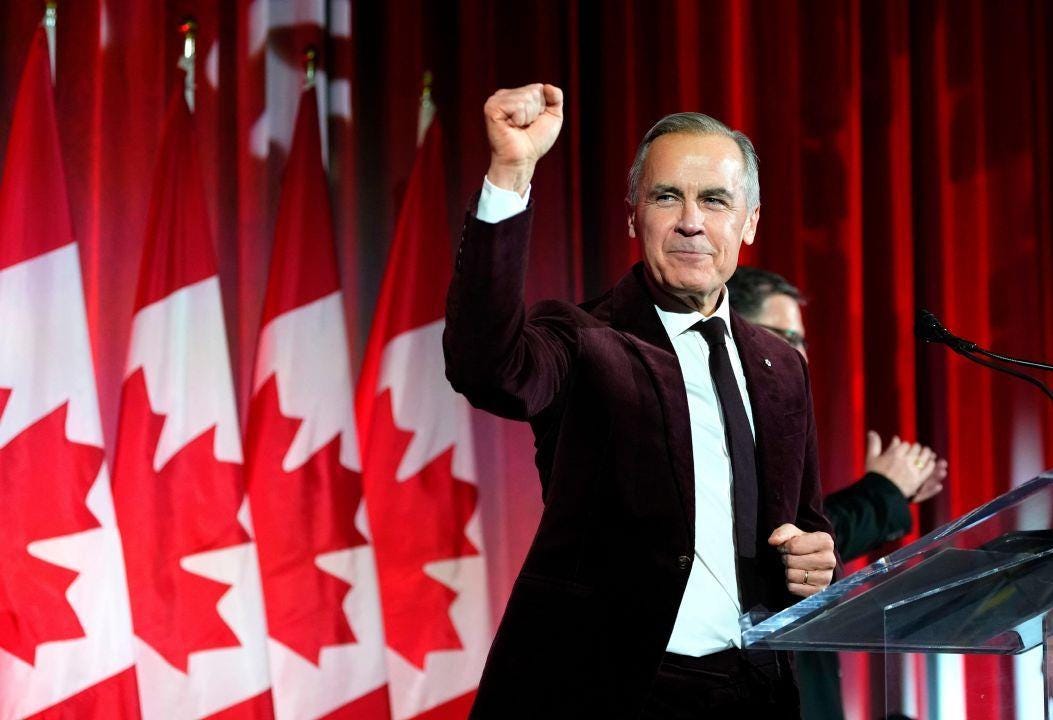
Prime Minister Mark Carney and the Liberal Party of Canada were given a mandate by the voters in the April 2025 federal election to build — as their slogan went — a “Canada Strong” or in French, “Un Canada fort.” On the campaign trail, Carney spoke candidly about the importance of this moment, saying that Trump wants to “break us, so that America can own us.” He vowed to make sure such a crisis could never happen again and that Canada would remain the true north strong and free. Now, the Central Banker turned Prime Minister has to deliver.
Austerity, again?
In 1995, the Wall Street Journal published an editorial titled Bankrupt Canada? written by right-wing pundit John Fund (notably, not an economist), predicting that Canada could become a third world country due to spiraling debt. In 1993, the Liberal Party had been swept into power with a mandate to tackle economic stagnation, a declining Canadian dollar, and rising debt as a percentage of GDP. Although everyone expected cuts, it was Manhattan boardrooms that made them historically brutal. This editorial, combined with threats of a rating downgrade from Moody’s, helped persuade PM Jean Chrétien and Finance Minister Paul Martin to massively deepen their cuts to public expenditures to 20% across the board, despite backlash from bleeding-heart Liberal backbenchers. The cuts successfully reduced debt, and restored international confidence in Canadian markets. From a different point of view, primary care access for Canadian patients was slashed due to Canadian dependence on appeasing American investors and their newspapers.
I bring this up because Mark Carney, like Paul Martin before him, is reintroducing austerity as a hallmark of Liberal administration. Carney’s FY 2026 budget is asking most departments to find 15% in cuts, laying off over 40,000 public servants — where healthcare services in particular will feel the hurt. What do these budgets have in common besides cuts? They’re influenced by economic dependence on the United States. Whereas in 1995 it was signals deployed from elite American institutions directing a change in a policy, this time it’s belt-tightening made necessary by a direct presidential power-grab. Once again, Canada surrenders substantive sovereignty over crucial fiscal policy to Washington.
Now, to be fair, the economic conditions we live in are compelling many governments to scrounge for savings. My time working in the Vermont state legislature gave me a very direct experience in that. Furthermore, Carney seems to a have a long-term vision of making Canada less reliant on the United States, which was not a feature of Paul Martin’s political project. Nevertheless, I challenge the necessity of this austerity. Especially not while Carney accompanies these cuts with a bevy of tax breaks for millionaires and billionaires, including scrapping the tax on yachts, scrapping the digital services tax on large tech firms (a Trump demand by the way), and slashing capital gains taxes. At what point does fiscal necessity turn into an ideological war on “government bloat?”
Frankly at this time I am less concerned about bloat and more concerned about declining public services. At a time when rising waiting times threaten to undermine confidence in Canadian Medicare, understaffed Canada Revenue Agency call centers can only return a correct answer to taxpayers seeking help 17% of the time (yes, 17%), and student performance is lacking, I am not convinced that starving vital services to finance tax giveaways is a sound bet. While capital flight is more of a concern in Canada then the United States (where the threat of which is routinely bluffed to stop minor tax increases on the wealthy), I’d like to see more of an “elbows up” mindset applied to the wealthy, not just to ordinary Canadians expected to shoulder necessary sacrifices. That way, public services can remain credible, strong, and something to be proud of in a time of severe disturbance. It’ll also be a powerful signal that American policymakers can’t dictate terms to Ottawa.
A 21st Century National Policy
The “National Policy” originated with Canada’s first Prime Minister, John A. Macdonald, as a strategy to develop an independent Canadian state capable of withstanding the pressure of annexation from the United States. This policy combined protective tariffs on newborn Canadian industries and state investment in physical infrastructure spanning Canada’s wide and often hostile geography. The National Policy is widely credited with defending Canadian independence in its cradle, but was gradually dismantled over the course of the 20th century in the name of market efficiency. While still-intact trade agreements between Canada and the United States limit Canada’s potential measures, recent events make the construction of a 21st century National Policy very compelling.
Mark Carney seems to be thinking along these lines, given that he has embarked on a serious of government-backed “nation-building” infrastructure projects including but not limited to hydroelectric dams, ports, power lines, mines, and more. At a time when American firms already control large swathes of Canada’s infrastructure and resource economy — and are looking for more — these projects are definitely a good start. It may be worth thinking even bigger however.
Partially as a response to Silent Surrender, Canadian federal and provincial governments made combating foreign resource ownership a bigger priority in the 1970s. New Democratic governments in British Columbia and Saskatchewan nationalized large swathes of the lumber and potash industries respectively, while PM Pierre Elliot Trudeau created a state-owned oil company. These policies were, for the most part, dismantled in the name of market efficiency and continental integration over the course of the next three decades. Obvious recent developments however, I believe, merit a second look at proactive “Canadianization.”
Despite trade tensions, American firms continue to eye up untapped energy reserves in Canada, and finalize deals to buy up Canadian mines and water infrastructure. At the very least, Carney could seek to tighten existing regulations meant to keep resources in Canadian hands: more national security reviews, giving Canadian firms the right to match American offers, and so on. But I’d argue to go a step further, including bringing back the Crown Corporation to develop certain resources, or even have the state buy up controlling shares in assets as risk of entering foreign ownership. It’s possible that American authorities would cry foul and claim a violation of trade agreements, but it would certainly be ironic coming from the progenitors of the present trade war. If Trump wants to be a muscular economic nationalist, then Carney shouldn’t hesitate to reach into Canada’s own heritage to do the same.
Geopolitical Autonomy
Upon becoming Prime Minister in March, 2025, the first countries Mark Carney visited were the United Kingdom and France. These countries both played a historical role in colonizing what is today called Canada, but crucially were also not the United States. Carney was sending an undisguised signal that Canada was turning to the rest of the world. This is a welcome change. As Trump’s foreign policy prioritizes fanning the flames of far-right politics in Europe, techno-futurist ethnic cleansing in Gaza, looting and then selling out Ukraine, and of course, bullying Canada, the necessity of reasserting Canada’s independent position on the world stage is more important then ever. Carney has taken a variety of steps to do so, the largest of which may be including over $80 billion in new defense spending in his FY 2026 budget.
Typically, progressives oppose new military spending because it usually comes at the expense of social programs and makes war more likely. I’m not totally unsympathetic to those objections, but I’ll step forward as a rare left-wing voice in favor of growing Canada’s military budget. Not only is the deliberate underfunding of Canada’s military having dire consequences on servicemen and women — an Auditor General’s report showed bases failing to meet basic living standards — but this austerity is a result of outsourcing Canada’s security to the United States. Obviously, this shifts a lot of power and influence to Washington. In order for Canada to reassert its sovereignty, it has to take responsibility for its own security — and that means funding the Armed Forces. So I support Carney’s moves to do just that, but I want to qualify this in strong terms. Canadian rearmament cannot be structured as a giveaway to the American military-industrial complex or in the service of American foreign policy, and doing so would be worse then doing nothing at all.
That means, for starters, that Carney should absolutely not approve a Canadian purchase of American F-35s, or participate in Trump’s “Golden Dome” missile defense boondoggle as he has considered doing. Refitting Canada’s military with American equipment would not only mean massive giveaways by taxpayers to American companies, but it would make Canada more reliant on the United States for security, not less. Sweden has put forward a compelling offer to sell fighter jets to Canada, and not only would this be better regarding sovereignty, but the jets would be manufactured in Canada, creating thousands of jobs. Carney has made encouraging moves that he recognizes the necessity of diversifying Canada’s weapons supply, including securing Canadian inclusion in Europe’s defense financing program, but I think we’ll have to wait and see to know how serious he is not just about military spending, but about independent military policy.
Since World War Two, Canada has been a reliable supporter of American foreign policy, and even exceptions around Iraq and Cuba that I mentioned earlier were exceptions that proved the rule. Today, Donald Trump’s capricious and plundering foreign policy gives Canada an opportunity to draw ever sharper distinctions between Washington’s line and Ottawa’s. This is an important opportunity, because an independent military policy necessarily requires an independent foreign policy.
In this respect, Mark Carney has often refrained from contradicting Trump’s policies outside of those affecting Canada directly with one major exception: Palestine. In September, Canada broke with its own precedent and American policy by unilaterally recognizing the State of Palestine. In his statement, Carney issued criticisms of Israeli policy that would be unheard of from either the Biden or Trump Administrations.
The current Israeli government is working methodically to prevent the prospect of a Palestinian state from ever being established. It has pursued an unrelenting policy of settlement expansion in the West Bank, which is illegal under international law. Its sustained assault in Gaza has killed tens of thousands of civilians, displaced well over one million people, and caused a devastating and preventable famine in violation of international law. It is now the avowed policy of the current Israeli government that ‘there will be no Palestinian state’.
The White House was furious, with Trump even threatening economic consequences for the act, opening a major fissure between the two countries. PM Carney is a cautious leader who is unlikely to rock the boat further while trade negotiations are ongoing, but I think he has a unique opportunity to go one step more on this issue. Not only does the Canadian public favor a strong moral stance against Israel’s behavior in the West Bank and Gaza, but the issue represents an easily available opportunity to draw a necessary distinction between Canada’s position and that of the United States. I’d consider measures to sharpen Canada’s position, such as closing loopholes that allow Canadian war materials to go to Israel despite official Canadian policy restricting such exports, but also moves to increase the power of Canada’s voice, such as upping Canadian contributions to the United Nations Relief and Works Agency for Palestine Refugees in the Near East (UNWRA).
Trump’s attacks on Canada and Denmark, as well as his eagerness to appease Russia have already forced other NATO leaders to plan for a world without the alliance. Trump’s and his allies in the tech oligarchy promotion of far-right nationalist politics in Europe has even forced governments to consider the United States an adversary. In some respects, Canada — short of having a Trumpist right-wing nationalist government of its own, and I should hope this never happens — is already being forced to find new geopolitical footing. For Canadians who have come to enjoy peace and quiet as America’s polite friend, this may invite worry, but it also presents an opportunity to be embraced. Canada has a unique opportunity to further define its national identity by developing a stronger, more Canadian voice on the world stage, and I think there is a lot of potential.
A Note on My Position
I approach this issue from multiple perspectives and identities, none of which can be excluded from my analysis. I am at once a proud American and a proud Canadian, while also holding a certain set of universal principles which transcend national borders. When I think of the present trade war, I think of businesses in Vermont I know well which have suffered or even failed from lack of Canadian tourism, but I also think of Canadian friends and relatives who worry for their own jobs and livelihoods. As a child, I was always taught that the United States and Canada enjoyed a sincere friendship that was so rare in the world and this was comforting for a child who had family on both sides of the border. It has been heartbreaking to watch that idea dissolve before me this past year. All of this was avoidable, none of this was necessary, and we all deserve better.
But I would be remiss if I did not note how I have embraced my Canadian identity with renewed enthusiasm. Watching Donald Trump and his underlings insult and belittle Canada made my blood boil. It nurtured my pride in being Canadian. I purchased a Canadian flag for my apartment when the tariffs came down. I went from sobbing when Sidney Crosby scored the overtime winner to defeat Team USA in the Gold Medal game of the 2010 Winter Olympics to hollering for joy in the snow-covered streets of Burlington when Connor McDavid scored the game-winner to lift Team Canada over Team USA in the 2025 Four Nations Face-Off.
Not for a moment have I sacrificed what makes me an American, but I sincerely believe that given the toxic nature of a Trump-led United States, that Canada must end the relationship of ever-deeper integration it has pursued for the past several decades. It is the best option not just for Canadians, but for Americans who are against this regime, because an independent Canada can serve as an ideal to aspire to for our own country. In Canadian resistance to Trump, we can see a cause worthwhile of all of us. It is my highest hope that one day, the United States and Canada can enjoy renewed friendship on the basis of mutual respect. That, more then anything, would make me happy.
What will define the 21st Century is how America's liberal democratic allies are able to focus on their own institutions and decouple from an unstable superpower ruled by the most idiotic people to ever live. While a full decoupling from the United States is impossible and inadvisable (for now), it is perfectly reasonable for some level of protectionism over economic resources, domestic defense spending, and political sovereignty. I am glad the Canadians are following suit, and I fully support their efforts at selectively disassociating from the US economy.